
PROJECT WWWN
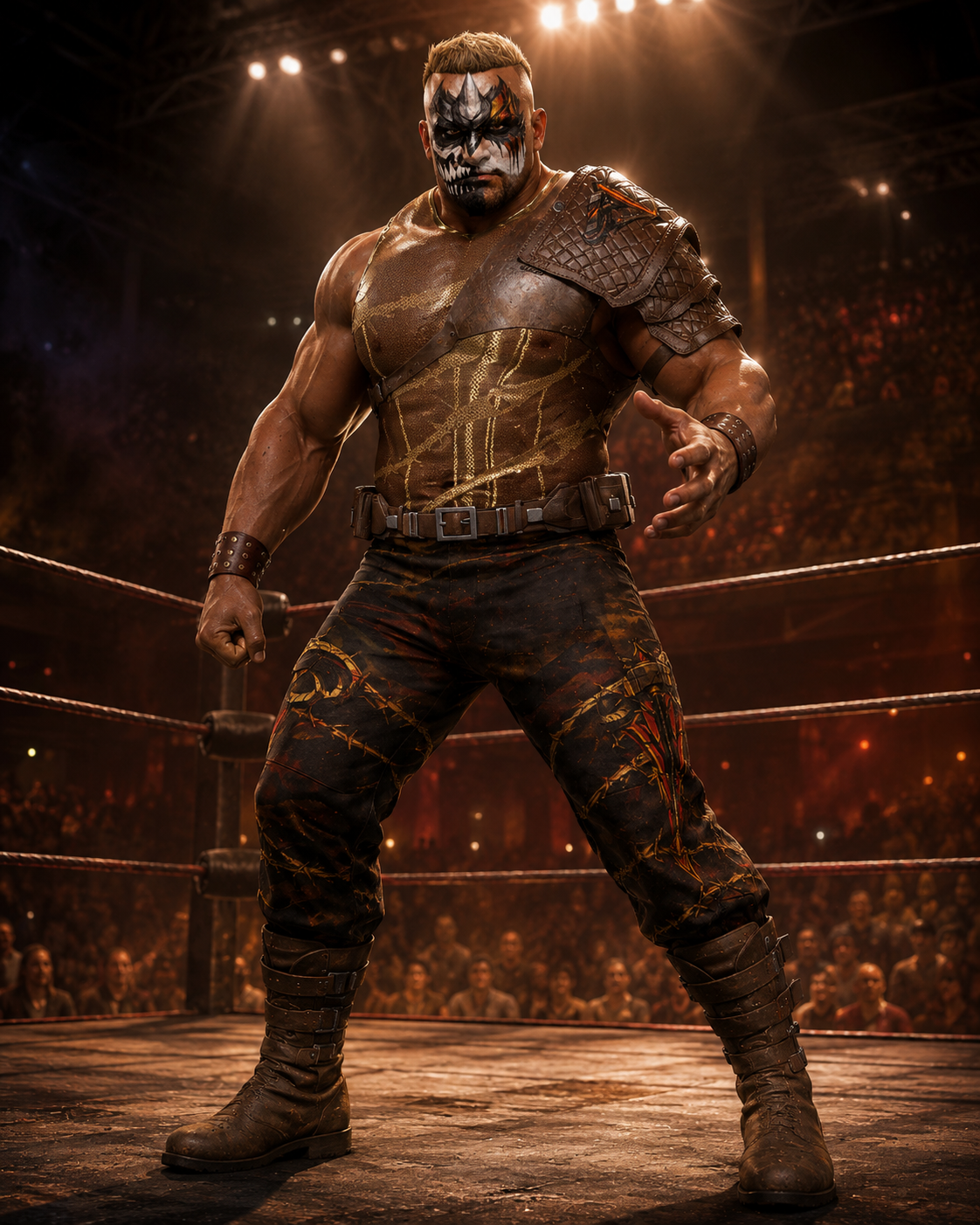
Billed From | Height | Weight | Wrestling Style |
|---|---|---|---|
The Iron Range | 6’3” | 284 lbs | Powerhouse, Striker, American |
Signature Moves | Trademark Moves | Inspired By | Fights Like |
|---|---|---|---|
Running Leaping Shoulder Block
Short-Arm Clothesline
Delayed Vertical Suplex
Back Elbow Strike
Belly-to-Back Suplexs | Thrust Spinebuster
Snap Scoop Powerslam (Pin Combo)
Full Nelson Slam
Final Prayer
Running Powerslam | 1980’s Power Teams | Ron Simmons
Hawk
Sting
British Bulldog
Akam
Warlord
Ax
Konnor
Brian Adams |
Trained By | Theme | Video Link |
|---|---|---|
Profile Overview |
|---|
Brutus Caine emerged from the industrial brutality of The Iron Range, a region where strength is not a virtue but a requirement for survival. Raised in a culture defined by labor, grit, and blunt honesty, Caine learned early that hesitation invites weakness. His persona is not theatrical; it is utilitarian. He carries himself with the posture of a man who expects resistance and welcomes it. In the ring, he represents forward motion and controlled destruction. Caine does not posture for applause nor beg for it. His presence is defined by silence, heavy breathing, and the certainty that something violent is about to happen. He is not flashy, not acrobatic, and not interested in spectacle. He believes dominance should be simple and decisive. Every match for Brutus Caine is a test of whether his opponent can withstand sustained force.
His journey through WWWN has been shaped by partnership and loyalty, most notably as one-half of Hammerfall. While Magnus Roark provides structural control and ideological framing, Caine supplies impact and enforcement. He thrives in environments where order is being contested, stepping forward as the physical consequence to those who resist hierarchy. Caine does not interfere for drama; he intervenes to restore momentum. He has positioned himself as a gatekeeper in the heavyweight and tag divisions, often standing between rising contenders and their breakthrough moment. Within faction dynamics, he is unwaveringly loyal, rarely questioning strategy but always executing it with precision. His wrestling philosophy is rooted in efficiency — reduce motion, maximize impact, end the fight. When aligned with authority or structure, he becomes an enforcer of standards rather than a chaotic aggressor. This consistency has made him both respected and feared across locker rooms.
In the larger WWWN ecosystem, Brutus Caine functions as a measuring stick for legitimacy. If a competitor defeats him cleanly, their ascent feels earned. If he defeats them decisively, their weaknesses are exposed without ambiguity. Fans react to him based on context rather than charisma; when positioned against arrogance or cowardice, he becomes a brutal hero. When aligned against beloved underdogs, he becomes an oppressive obstacle. His legacy is being forged not through speeches but through impact moments — spinebusters that shake the mat, shoulder blocks that flip momentum instantly, and finishes that arrive without warning. Caine does not chase myth; he creates it through repetition and force. He is not interested in popularity, only results. In WWWN, he is the hammer that falls when the structure demands reinforcement.
Rei stands as proof that the executioner’s role never truly ends; it merely finds a new bearer. |
Brutus Caine emerged from the industrial brutality of The Iron Range, a region where strength is not a virtue but a requirement for survival. Raised in a culture defined by labor, grit, and blunt honesty, Caine learned early that hesitation invites weakness. His persona is not theatrical; it is utilitarian. He carries himself with the posture of a man who expects resistance and welcomes it. In the ring, he represents forward motion and controlled destruction. Caine does not posture for applause nor beg for it. His presence is defined by silence, heavy breathing, and the certainty that something violent is about to happen. He is not flashy, not acrobatic, and not interested in spectacle. He believes dominance should be simple and decisive. Every match for Brutus Caine is a test of whether his opponent can withstand sustained force.
His journey through WWWN has been shaped by partnership and loyalty, most notably as one-half of Hammerfall. While Magnus Roark provides structural control and ideological framing, Caine supplies impact and enforcement. He thrives in environments where order is being contested, stepping forward as the physical consequence to those who resist hierarchy. Caine does not interfere for drama; he intervenes to restore momentum. He has positioned himself as a gatekeeper in the heavyweight and tag divisions, often standing between rising contenders and their breakthrough moment. Within faction dynamics, he is unwaveringly loyal, rarely questioning strategy but always executing it with precision. His wrestling philosophy is rooted in efficiency — reduce motion, maximize impact, end the fight. When aligned with authority or structure, he becomes an enforcer of standards rather than a chaotic aggressor. This consistency has made him both respected and feared across locker rooms.
In the larger WWWN ecosystem, Brutus Caine functions as a measuring stick for legitimacy. If a competitor defeats him cleanly, their ascent feels earned. If he defeats them decisively, their weaknesses are exposed without ambiguity. Fans react to him based on context rather than charisma; when positioned against arrogance or cowardice, he becomes a brutal hero. When aligned against beloved underdogs, he becomes an oppressive obstacle. His legacy is being forged not through speeches but through impact moments — spinebusters that shake the mat, shoulder blocks that flip momentum instantly, and finishes that arrive without warning. Caine does not chase myth; he creates it through repetition and force. He is not interested in popularity, only results. In WWWN, he is the hammer that falls when the structure demands reinforcement.
Rei stands as proof that the executioner’s role never truly ends; it merely finds a new bearer.
Profile Wrestling Style |
|---|
Brutus Caine performs with a burst-and-spike rhythm that prioritizes acceleration over prolonged technical exchanges. He opens matches with forward pressure, often initiating contact with running shoulder blocks that immediately test an opponent’s stability. His strikes are compact and heavy, favoring back elbows and short-arm lariats that close distance quickly. When transitioning into grapples, Caine prefers vertical suplexes and belly-to-back throws that reset control to the center of the ring. He rarely climbs the ropes, instead choosing grounded power that keeps his base secure. His pacing allows for brief explosive sequences followed by calculated resets before another violent surge. The Thrust Spinebuster often serves as a turning point, shifting matches decisively in his favor. From there, he escalates directly into finishing territory without excessive theatrics.
Psychologically, Caine wrestles with discipline and purpose. He does not taunt excessively, and he rarely wastes energy arguing with referees. His aggression is channeled rather than reckless, making him difficult to bait into mistakes. He values clean finishes but will escalate intensity if provoked. In tag environments, he functions as the accelerator — entering the ring to deliver rapid-impact sequences that destabilize opponents before tagging back out. His offense communicates inevitability rather than chaos. The Iron Dominion serves as a definitive exclamation point, delivering high-angle impact that feels terminal. Ultimately, Brutus Caine’s style embodies controlled brutality: straightforward, forceful, and uncompromising. |
Brutus Caine performs with a burst-and-spike rhythm that prioritizes acceleration over prolonged technical exchanges. He opens matches with forward pressure, often initiating contact with running shoulder blocks that immediately test an opponent’s stability. His strikes are compact and heavy, favoring back elbows and short-arm lariats that close distance quickly. When transitioning into grapples, Caine prefers vertical suplexes and belly-to-back throws that reset control to the center of the ring. He rarely climbs the ropes, instead choosing grounded power that keeps his base secure. His pacing allows for brief explosive sequences followed by calculated resets before another violent surge. The Thrust Spinebuster often serves as a turning point, shifting matches decisively in his favor. From there, he escalates directly into finishing territory without excessive theatrics.
Psychologically, Caine wrestles with discipline and purpose. He does not taunt excessively, and he rarely wastes energy arguing with referees. His aggression is channeled rather than reckless, making him difficult to bait into mistakes. He values clean finishes but will escalate intensity if provoked. In tag environments, he functions as the accelerator — entering the ring to deliver rapid-impact sequences that destabilize opponents before tagging back out. His offense communicates inevitability rather than chaos. The Iron Dominion serves as a definitive exclamation point, delivering high-angle impact that feels terminal. Ultimately, Brutus Caine’s style embodies controlled brutality: straightforward, forceful, and uncompromising.