
PROJECT WWWN
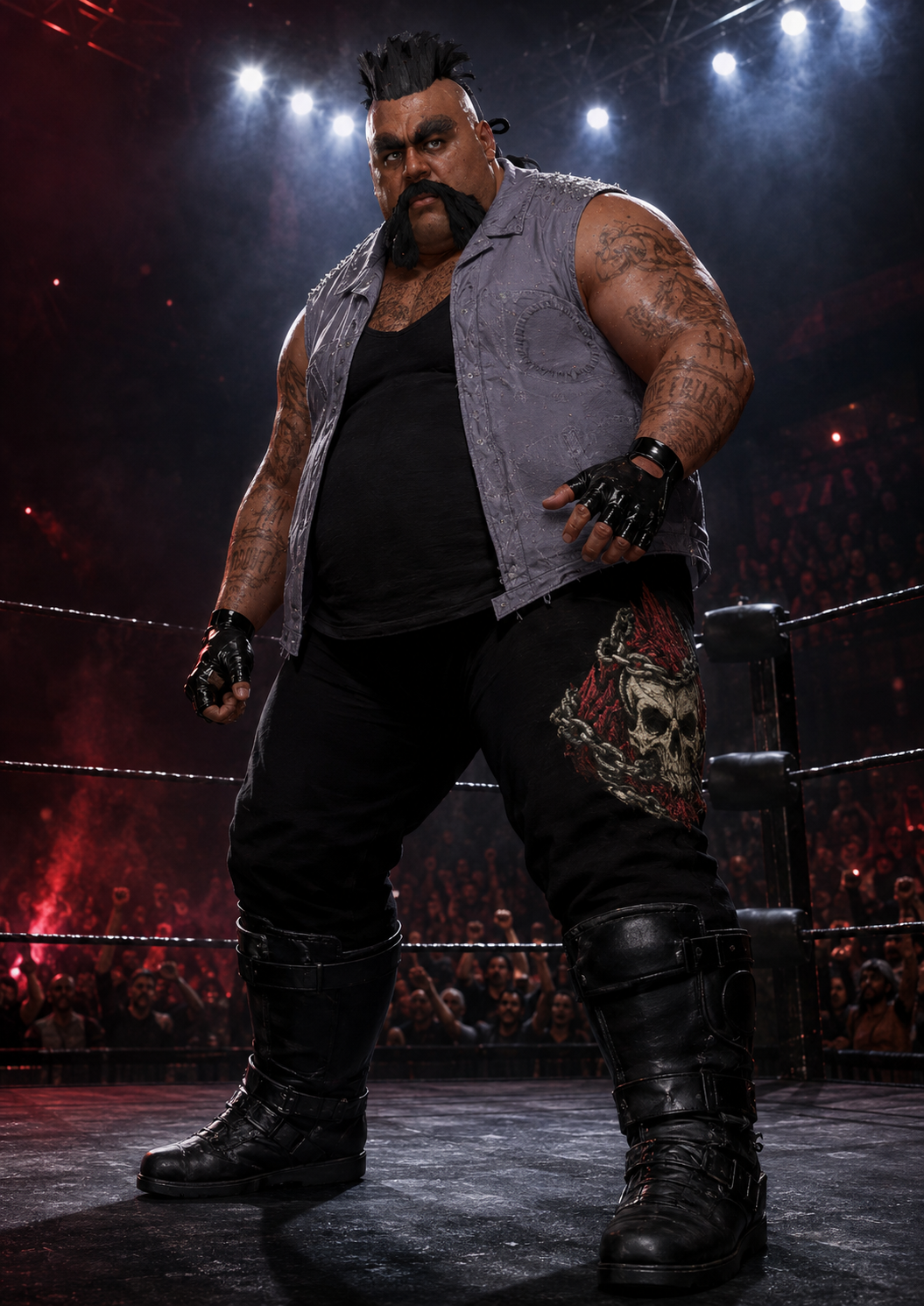
Billed From | Height | Weight | Wrestling Style |
|---|---|---|---|
The County Line, North Carolina | 6'7" | 389 lbs | Giant
Powerhouse
Hardcore |
Signature Moves | Trademark Moves | Inspired By | Fights Like |
|---|---|---|---|
Spinebuster, Running Knee Lift, Short-Arm Lariat, Delayed Vertical Suplex, Corner Shoulder Blocks | The Last Count — Big Splash followed by an arrogant five-count cover
County Line Collapse — Chokeslam Backbreaker
Blackwell Bomb — Military Press Powerslam
The Hurtin’ Hand — Heart Punch
Five Makes It Finished — Vader Bomb-style Corner Slingshot Splash | The Token Big Man | Big John Studd
King Kong Bundy
Ox Baker
Mabel
Matt Morgan
One Man Gang
Norman the Lunatic
Rosey
Vader
911
Kongo Kong |
Trained By | Theme | Video Link |
|---|---|---|
Major Tom Colt
Powder Keg Sampson | All About the Victory | https://music.youtube.com/watch?v=bQar5sWaKT8&si=Bl5Dx9R7QtwlML8- |
Profile Overview |
|---|
Amos Blackwell was not discovered in a wrestling school, a college gym, or a championship committee scouting report. He was found in the kind of place where the pavement gives up and the dirt road starts making its own rules. The story goes that Blackwell worked security at county fairs, roadside carnivals, outlaw mud runs, and backroom fight nights where the law only arrived after the money had already changed hands. People did not remember what he said because he rarely said much. They remembered the way crowds parted when he walked through them. They remembered the way smaller men suddenly found manners when he looked down at them. His size made him useful, but his temper made him dangerous. For years, promoters treated him like a problem to be rented instead of a wrestler to be trained. Amos learned early that people did not respect a giant unless the giant made them count the cost.
When Major Tom Colt finally brought Blackwell into the orbit of WWWN, the idea was not to polish him into a hero. Colt saw him as a human consequence, the kind of man who could make reckless wrestlers regret confusing courage with stupidity. Powder Keg Sampson helped put enough structure around Blackwell’s violence to make him usable without making him safe. That is the key to Amos Blackwell: he is not untrained, and he is not stupid. He is slow when he wants to be slow, cruel when he wants the crowd to feel the wait, and sudden when an opponent mistakes his size for bad timing. His obsession with the count became his calling card after a referee stopped a match at three and Amos refused to move. He kept his full weight across the opponent’s chest and held up two more fingers. From that night on, he stopped seeing a three-count as victory. In his mind, three means beaten, but five means finished.
Amos Blackwell enters WWWN as a monster attraction who does not fit neatly into any faction’s mission statement. He is too territorial for The BluePrint, too grounded for The Hollow Creed, and too blunt for any political machine to control for long. He works best as a hired disaster, a tournament spoiler, or a Brass Knuckles threat who can cross into the World Heavyweight division when the company needs the ground to shake. Fans may boo him, fear him, or sometimes cheer the destruction, but nobody treats him like filler. Blackwell is the kind of wrestler who changes the mood of a match card just by appearing on the graphic. His opponents do not game-plan for victory first; they game-plan for survival. In WWWN, he represents the old fear of the giant brought into a modern world that thinks everything can be measured, branded, and controlled. Amos Blackwell exists to remind everyone that some things are only measured by how long it takes them to get back up. When he presses a man into the mat and raises his hand for the final count, the building knows exactly what comes next. |
Amos Blackwell was not discovered in a wrestling school, a college gym, or a championship committee scouting report. He was found in the kind of place where the pavement gives up and the dirt road starts making its own rules. The story goes that Blackwell worked security at county fairs, roadside carnivals, outlaw mud runs, and backroom fight nights where the law only arrived after the money had already changed hands. People did not remember what he said because he rarely said much. They remembered the way crowds parted when he walked through them. They remembered the way smaller men suddenly found manners when he looked down at them. His size made him useful, but his temper made him dangerous. For years, promoters treated him like a problem to be rented instead of a wrestler to be trained. Amos learned early that people did not respect a giant unless the giant made them count the cost.
When Major Tom Colt finally brought Blackwell into the orbit of WWWN, the idea was not to polish him into a hero. Colt saw him as a human consequence, the kind of man who could make reckless wrestlers regret confusing courage with stupidity. Powder Keg Sampson helped put enough structure around Blackwell’s violence to make him usable without making him safe. That is the key to Amos Blackwell: he is not untrained, and he is not stupid. He is slow when he wants to be slow, cruel when he wants the crowd to feel the wait, and sudden when an opponent mistakes his size for bad timing. His obsession with the count became his calling card after a referee stopped a match at three and Amos refused to move. He kept his full weight across the opponent’s chest and held up two more fingers. From that night on, he stopped seeing a three-count as victory. In his mind, three means beaten, but five means finished.
Amos Blackwell enters WWWN as a monster attraction who does not fit neatly into any faction’s mission statement. He is too territorial for The BluePrint, too grounded for The Hollow Creed, and too blunt for any political machine to control for long. He works best as a hired disaster, a tournament spoiler, or a Brass Knuckles threat who can cross into the World Heavyweight division when the company needs the ground to shake. Fans may boo him, fear him, or sometimes cheer the destruction, but nobody treats him like filler. Blackwell is the kind of wrestler who changes the mood of a match card just by appearing on the graphic. His opponents do not game-plan for victory first; they game-plan for survival. In WWWN, he represents the old fear of the giant brought into a modern world that thinks everything can be measured, branded, and controlled. Amos Blackwell exists to remind everyone that some things are only measured by how long it takes them to get back up. When he presses a man into the mat and raises his hand for the final count, the building knows exactly what comes next.
Profile Wrestling Style |
|---|
Amos Blackwell wrestles like a wall that learned how to hate. His pace is deliberate, heavy, and suffocating, built around making opponents carry his weight before he ever attempts a finishing blow. He uses corner avalanches, bearhugs, chokelifts, clubbing forearms, and body blocks to take away breathing room. Once an opponent slows down, Blackwell turns the match into punishment by leaning on them, stepping on them, and dragging them back into danger. He is not a flashy superheavyweight, but he does have short bursts of shocking movement when the match calls for it. A sudden running splash, corner cannonball, or slingshot body press should feel like a building falling the wrong direction. His best matches are not fast; they are tense, uncomfortable, and built around the question of whether the opponent can survive long enough to make him doubt himself.
Psychologically, Blackwell is defined by control, humiliation, and count obsession. He wants opponents to know they are trapped before they are beaten. He often breaks his own cover at two just to restart the punishment, then demands the referee count louder when he finally decides the match is over. The five-count is not only a tribute to old monster wrestling; it is Amos’s personal philosophy. Three is the rulebook’s ending, but five is his ending. That makes him especially dangerous in WWWN because he treats victory as incomplete unless it leaves a mark. Against smaller opponents, he becomes a horror movie. Against other powerhouses, he becomes a territorial bull defending space. Against champions, he becomes a measuring stick no one wants to be measured against.in slower matches where psychology and timing matter, forcing faster opponents into uncomfortable positions and capitalizing on their frustration |
Amos Blackwell wrestles like a wall that learned how to hate. His pace is deliberate, heavy, and suffocating, built around making opponents carry his weight before he ever attempts a finishing blow. He uses corner avalanches, bearhugs, chokelifts, clubbing forearms, and body blocks to take away breathing room. Once an opponent slows down, Blackwell turns the match into punishment by leaning on them, stepping on them, and dragging them back into danger. He is not a flashy superheavyweight, but he does have short bursts of shocking movement when the match calls for it. A sudden running splash, corner cannonball, or slingshot body press should feel like a building falling the wrong direction. His best matches are not fast; they are tense, uncomfortable, and built around the question of whether the opponent can survive long enough to make him doubt himself.
Psychologically, Blackwell is defined by control, humiliation, and count obsession. He wants opponents to know they are trapped before they are beaten. He often breaks his own cover at two just to restart the punishment, then demands the referee count louder when he finally decides the match is over. The five-count is not only a tribute to old monster wrestling; it is Amos’s personal philosophy. Three is the rulebook’s ending, but five is his ending. That makes him especially dangerous in WWWN because he treats victory as incomplete unless it leaves a mark. Against smaller opponents, he becomes a horror movie. Against other powerhouses, he becomes a territorial bull defending space. Against champions, he becomes a measuring stick no one wants to be measured against.in slower matches where psychology and timing matter, forcing faster opponents into uncomfortable positions and capitalizing on their frustration